What Is Underdrawing in a Painting?
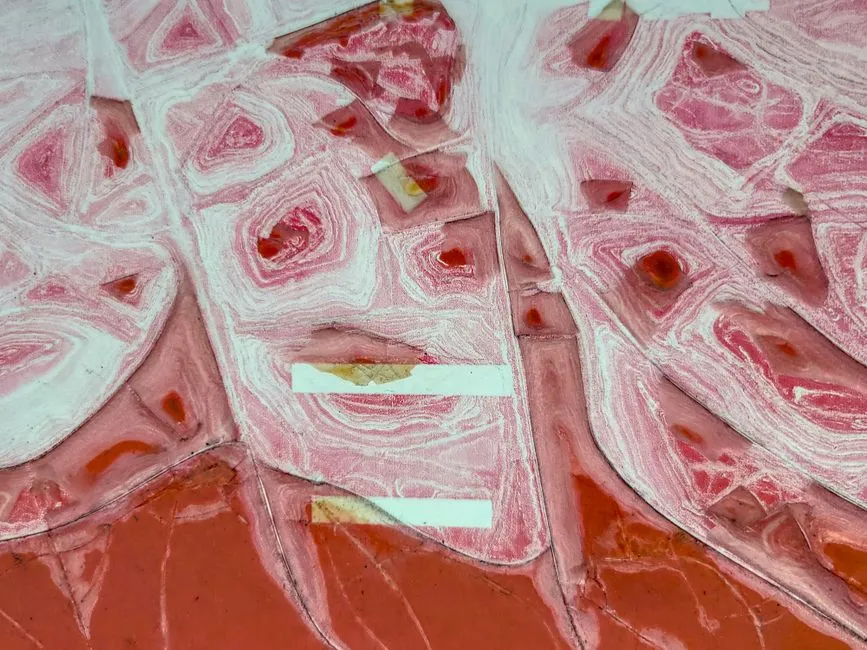
Underdrawing is a plan beneath the paint
Underdrawing is the preliminary drawing of a composition on a prepared painting support. It can establish contours, figures, perspective, drapery, shadows, architecture, or other placement before later paint layers develop the image.
The National Gallery's glossary defines it as preliminary outlining on a primed support and notes that it may remain visible, reappear, or be revealed with infrared reflectography. That is a useful definition, not a promise that every painting contains one detectable drawing.
It sits within a larger layer structure
A traditional painting may include a support such as panel or canvas, preparation or ground, underdrawing, preliminary paint layers, later paint, glazes, and surface coatings. Real objects do not always follow that neat diagram. Artists vary their methods, combine stages, work over older compositions, reuse supports, or change materials within one picture.
Underdrawing is primarily linear or graphic planning. Underpainting uses paint beneath later paint to establish tonal masses, local color, modeling, or another foundation. A work can contain both, one, or neither as a clearly separable stage.
The working-method guides use those terms descriptively. They do not treat a visible dark line as automatically original, preparatory, or made by the named artist.
Artists could change the plan
Underdrawing was not always traced obediently. A painter might move a hand, alter a fold, revise architecture, change the direction of a face, or abandon an entire element during painting. Technical researchers call visible differences between an earlier design and the final image changes in composition; specific terminology and interpretation depend on the evidence.
Such changes can illuminate process, but they do not automatically reveal indecision, secret symbolism, or a dramatic personal crisis. A moved sleeve may simply be a moved sleeve. Art history becomes more reliable when a finding is allowed to be interesting before it is required to become cinematic.
Workshops complicate authorship. A design could be transferred, repeated, adapted, or executed by more than one person. Pattern, pricking, tracing, grids, incised lines, or freehand drawing can indicate different planning methods, but no single feature authenticates a work.
Infrared reflectography can reveal some drawings
Infrared reflectography records an artwork's response in infrared wavelengths. In favorable conditions, some paint layers transmit enough infrared for an underlying material—often a carbon-containing one—to create contrast in the image.
Results depend on:
- Wavelength range and imaging equipment
- Drawing material
- Pigments and binders above it
- Layer thickness and condition
- Support and ground
- Processing and interpretation
Some drawing materials do not contrast clearly. Some pigments remain opaque. Lines in an infrared image may overlap with cracks, changes, old restorations, transferred designs, or later interventions. “Nothing visible” means nothing was visible under those conditions, not that the artist faced the support without a plan and absolute confidence.
Other methods can complement infrared imaging. X-radiography, X-ray fluorescence mapping, reflectance imaging spectroscopy, microscopy, paint cross-sections, and material analysis answer different questions. Each has limits, and some require sampling or access available only to qualified conservation professionals.
Surface clues are not a home experiment
Viewers may see lines through thin paint or along contours. Photograph them where museum rules allow and compare the observation with published technical research. Do not use bright infrared lamps, ultraviolet lights, solvents, magnifiers that touch the surface, or improvised imaging on an artwork.
Changing varnish transparency, paint abrasion, age-related shifts, cracks, retouching, or an artist's deliberate exposed line can all affect what appears visible. Only object-specific examination can sort those possibilities.
The guide to reading a museum painting label shows how the accession number leads from a compressed wall label to the fuller collection record, where technical bulletins and conservation notes may be listed.
Underdrawing is evidence, not a confession
Researchers compare underdrawing across related works to study transfer methods, workshop practice, composition, chronology, and attribution. Strong conclusions join imaging with provenance, documents, style, construction, and material analysis.
For a visitor, the central insight is simple: a painting is not only its visible final surface. It is a layered object whose earlier decisions may survive imperfectly. Underdrawing gives some of those decisions a line—but responsible interpretation still has to color inside the evidence.